
Air-cooled chillers cut a modeled data center's on-site water 97%, but power plant water use rose 32%, preprint finds
University of Michigan researchers modeled a 200 MW data center on Michigan's grid. Total water fell 44% with air-cooled chillers, and electricity use rose 32%.
Switching a modeled 200 MW data center from water-cooled to air-cooled chillers cut its on-site water consumption 97%, from 6.45 million cubic meters a year to 0.21 million, according to a preprint by three University of Michigan researchers posted Sept. 21. Facility electricity rose 32%, from 3.08 TWh to 4.06 TWh. The water consumed to generate that electricity also rose 32%, so total water use fell 44%. The paper has not been peer reviewed.
Garrett Alston, Nancy Love and Rabab Haider, of the university's Department of Civil and Environmental Engineering, placed a hypothetical facility in Oakland County, Mich. Their model links the facility's cooling and power demand to hourly dispatch of Michigan's power plants, the water each generator consumes, and monthly water depletion by watershed. The model's Michigan grid has 32.4 GW of installed capacity: 44.6% natural gas, 19.5% coal, 11.7% wind and 10.8% nuclear.
Three cooling cases
Annual results for the 200 MW IT load, as reported in the paper:
| Cooling system | Facility electricity | Direct water | Indirect water | Total water |
|---|---|---|---|---|
| Water-cooled chiller | 3.08 TWh | 6.45M m³ | 4.48M m³ | 10.93M m³ |
| Hybrid airside economizer with water-cooled chiller | 2.76 TWh | 3.20M m³ | 3.98M m³ | 7.19M m³ |
| Air-cooled chiller | 4.06 TWh | 0.21M m³ | 5.91M m³ | 6.12M m³ |
Direct water is consumed at the data center. Indirect water is consumed at power plants generating the facility's electricity.
The hybrid case used the least electricity. It switched to economizer mode on days with a mean temperature at or below 27 degrees C and mean relative humidity at or below 70%, which happened 25% of the year. With air-cooled chillers, 96.6% of the facility's total water footprint came from power generation.
"The results show that cooling configuration shifts water consumption from the facility to electricity generation," the authors wrote.
The authors note that "the DOE PUE and WUE values used represent estimated ranges rather than the true values of specific facilities," and that grouping Michigan into four grid regions limits how well the model captures transmission congestion. They also list fixed switching thresholds for the hybrid system, load profiles that don't separate AI training, inference and general workloads, and datasets from mixed years.
Proposed Michigan build-out
In a second scenario, the researchers modeled three proposed hyperscale facilities totaling 4,625 MW (2,700 MW, 1,400 MW and 525 MW), assuming liquid cooling with a waterside economizer and water-cooled chillers. The three used 36.22 TWh of electricity and 124.11 million m³ of water a year, 43% of it at power plants. Moving the facilities to alternative sites left the totals almost unchanged, at 124.13 million m³.
What suppliers say
Data Center Knowledge asked three industry suppliers about evaporative cooling. Matt Green, CEO of HVAC firm Brucker, told the publication that open-loop cooling still exists, "and it's really driven in many cases by upfront first cost," because "an open cooling tower is going to be less expensive." He estimated that open-loop systems cost 60% to 70% less upfront than closed-loop systems with comparable heat rejection.
"Water-cooled systems, as opposed to closed-loop air-cooled systems, are about 25% to 40% more efficient from an energy perspective," Brendan Mark, CEO of water treatment provider Capture H2O, told Data Center Knowledge. Ashlesa Mohapatra, quality manager at ServerLIFT, estimated that evaporative cooling uses 10% to 35% less electricity than closed-loop systems in peak summer, depending on climate and design.
Sources
- Data center cooling choices shift water impacts across the grid: An integrated water-energy model for sustainable data center development, Garrett Alston, Nancy Love and Rabab Haider, University of Michigan, arXiv preprint (not peer reviewed), Sept. 21, 2026
- Can Evaporative Cooling in Data Centers Still Make Sense?, Andy Patrizio, Data Center Knowledge, Oct. 23, 2026
Continue Reading
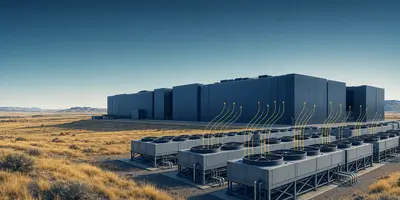
Google says its $17 billion Wyoming campus will be air-cooled as data center water use draws scrutiny
A study maps a quarter of the world's data centers in water-stressed areas. Tech companies and environmental groups are meeting on a national framework that covers water.
Voters in Ohio and Kansas set megawatt and water limits on data centers
Grove City, Ohio, will put any project above 20 megawatts or 500,000 gallons of water a day to a citywide vote. Several towns capped data centers at 25 megawatts. All results are unofficial.

California's data center water disclosure rules start Jan. 1, with drought plans required from 2028
Two new laws tie local permits and business licenses to water disclosures. Quorum counts 42 state data center measures that became law across the 2025 and 2026 sessions.
Stay Informed
New reports, delivered. Short, factual, and field-tested.