Google says its $17 billion Wyoming campus will be air-cooled as data center water use draws scrutiny
A study maps a quarter of the world's data centers in water-stressed areas. Tech companies and environmental groups are meeting on a national framework that covers water.
Key points
- Google said Nov. 5 that its $17 billion data center campus in Laramie County, Wyo., "will be air-cooled to minimize strain on local water resources." It gave no cooling equipment details or water figures.
- The campus will draw power from a 702 MW natural gas fuel cell development with carbon capture that American Electric Power is contracted to build, using Bloom Energy fuel cells.
- A study in Environmental Science & Technology mapped 9,347 data centers and found about 25% in areas that face water stress at least one month a year.
- Seven tech companies, including Google, are meeting with environmental groups through February 2027 on data center guidelines that cover water, AFP and The Hill reported.
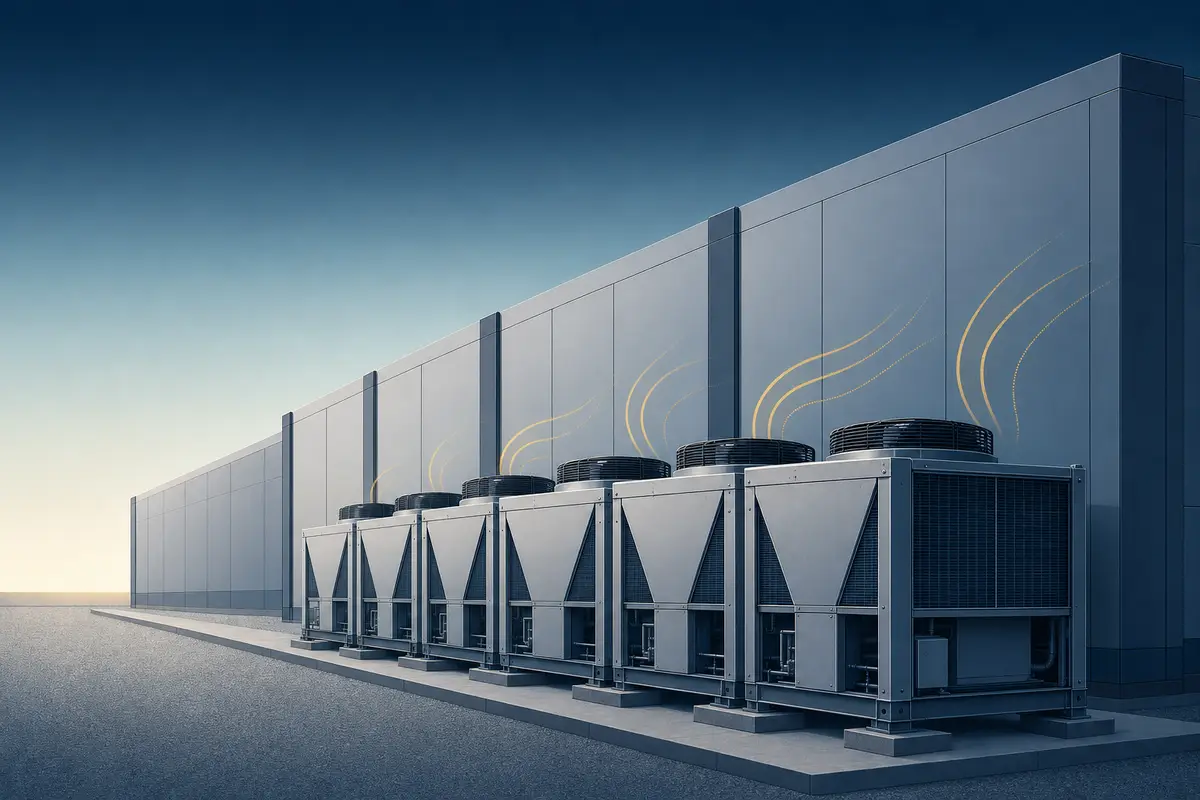
Google will cool its first Wyoming data center with air, the company said Nov. 5 in a blog post announcing a "long-term, $17 billion investment" in Laramie County, near Cheyenne. "Our Wyoming data center will be air-cooled to minimize strain on local water resources," wrote Steve Walter, Google's vice president of global infrastructure and energy. The post says Google is also "investing in local water replenishment efforts." It does not describe the cooling equipment or give water use figures.
Power will come mainly from a 702 MW natural gas fuel cell development with carbon capture and storage that American Electric Power is contracted to build, Google said. Bloom Energy makes the fuel cells, and captured carbon dioxide will be stored at Tallgrass' Eastern Wyoming Sequestration Hub. Google said it "will pay for 100% of the power we use." Tallgrass Energy, Black Hills Energy and Related Digital are also partners.
AEP's plant will cost about $4 billion and sell power to Google under a 20-year agreement, with full operation expected by the end of 2028, POWER magazine reported in October. Google's post gives no construction schedule. Grading at the site could begin this year, WyoFile reported. "This is not speculative. This is happening," Cheyenne Mayor Patrick Collins told WyoFile.
A quarter of data centers in water-stressed areas
Researchers led by Lorenzo Rosa of the Carnegie Institution for Science and Stanford mapped 9,347 operating data centers against local water availability, the American Chemical Society said Oct. 19 in a release on the study, published in Environmental Science & Technology. "About 25% of data centers are in areas that experience water stress at least one month each year, and around 6% are in areas that are stressed most of the year," the release says. The study counts an area as stressed when monthly water consumption exceeds the renewable supply.
Under a scenario about 3°C (5.4°F) warmer than 1900, which the release places 10 to 40 years from now, 33% of today's data centers could be in regions where water demand exceeds supply. Cities and towns are the largest water users near 41% of the data centers, and agriculture near another 28%, according to the release.
The United States hosts 39% of the data centers in the study, Rosa and co-author Matteo Sangiorgio wrote in a Nov. 3 World Economic Forum article. They wrote that slightly more than a fifth of U.S. sites are in areas with at least one water-scarce month.
The authors wrote that on-site cooling accounts for 28% of the water consumed across the data center supply chain, with the rest mostly off-site, including power generation. "Evaporative cooling typically consumes one to three cubic metres of water per megawatt-hour of computing," they wrote. "Air-based and closed-loop systems can cut on-site water use dramatically."
"These facilities are not landing in empty landscapes. They are landing on top of the water supply of cities and farms," Rosa said in the ACS release. The study does not report results for individual sites, including Laramie County.
Tech companies and environmental groups
Google, Meta, Microsoft, Oracle, Amazon, Nvidia and Anthropic are meeting with the Natural Resources Defense Council, WWF and the Sierra Club on national data center guidelines, AFP reported Nov. 6, citing a document it reviewed. AFP said the talks are backed by the Rockefeller Foundation and its affiliate Invest in Our Future, began in September and run through February 2027. Topics include energy and infrastructure, water and natural resources, community engagement, economic benefits, and transparency and accountability, according to AFP.
The Hill first reported the talks on Nov. 3. In the document The Hill reviewed, the group is called the Responsible Data Center Development Collaborative and seeks a "common national framework for responsible data development." The Hill listed the League of Conservation Voters and the U.S. Chamber of Commerce among participants. It did not mention WWF or the Rockefeller Foundation.
"We have participated in the early stages of this collaborative to be in conversation with a broad set of stakeholders," Holly Bender, the Sierra Club's chief program officer, told The Hill. Julie Cerqueira, NRDC's chief program officer, told The Hill that "it's important to have frontline community representation at every table." Neither report included comment from the tech companies. The document has not been made public.
Sources
- Investing in Wyoming's infrastructure, energy and workforce, Google, Nov. 5, 2026
- Google commits to spending $17B on AI data centers in Wyoming, WyoFile, Nov. 5, 2026
- AEP Plans $4 Billion Fuel Cell Power Plant for Google, POWER, Oct. 15, 2026
- Many data centers are located where water resources are limited, American Chemical Society via EurekAlert, Oct. 19, 2026
- One Quarter of Global Data Centers are Located in Water-Stressed Areas, Environmental Science & Technology, 2026
- A quarter of all data centres are now in water-stressed areas. Let's not make it a third, Lorenzo Rosa and Matteo Sangiorgio, World Economic Forum, Nov. 3, 2026
- Big Tech and green groups meet to discuss the future of data centres in the US, Euronews with AFP, Nov. 6, 2026
- Big Tech, environmental groups in talks for potential data center framework, The Hill via Yahoo News, Nov. 3, 2026
Continue Reading
Voters in Ohio and Kansas set megawatt and water limits on data centers
Grove City, Ohio, will put any project above 20 megawatts or 500,000 gallons of water a day to a citywide vote. Several towns capped data centers at 25 megawatts. All results are unofficial.

Air-cooled chillers cut a modeled data center's on-site water 97%, but power plant water use rose 32%, preprint finds
University of Michigan researchers modeled a 200 MW data center on Michigan's grid. Total water fell 44% with air-cooled chillers, and electricity use rose 32%.

California's data center water disclosure rules start Jan. 1, with drought plans required from 2028
Two new laws tie local permits and business licenses to water disclosures. Quorum counts 42 state data center measures that became law across the 2025 and 2026 sessions.
Stay Informed
New reports, delivered. Short, factual, and field-tested.