Chemours launches Faizeon two-phase cooling fluids a week after Vertiv adds fluid care services with Dow and Solenis
Chemours' five-fluid line covers direct-to-chip and immersion systems. Vertiv's new services cover flushing, filling, filtration, fluid chemistry and monitoring.
By The Gradient Report Staff
Key points
Chemours launched Faizeon, five two-phase cooling fluids for AI data centers: four for direct-to-chip cooling and one for immersion. It has not named the chemicals in them.
Chemours' data sheets list 100-year GWPs from 2.08 to 629, on two different IPCC bases, and boiling points from minus 29.5 to 48.9 degrees C.
Chemours says independent testing found a system using Faizeon 200 kept a GPU up to 19 degrees C cooler than a water-based fluid. The test report it cites, published by collaborator Accelsius, does not name the fluid.
Vertiv added fluid management services with Dow and Solenis, covering flushing, filling, filtration, fluid chemistry and monitoring.
Chemours launched Faizeon, a line of five two-phase liquid cooling fluids for AI data centers, on Nov. 2. Four are for two-phase direct-to-chip cooling and one is for immersion.
The grades, as Chemours describes them:
Faizeon 100: low-pressure direct-to-chip fluid.
Faizeon 110: low-pressure direct-to-chip fluid with an intermediate boiling point and zero ozone depletion potential.
Faizeon 200: direct-to-chip fluid for medium-pressure systems.
Faizeon 220: the company's highest-performance direct-to-chip fluid, for dense GPU, AI cluster and high-performance computing systems.
Faizeon 500: immersion fluid, formerly sold as Opteon 2P50.
The release says two-phase cooling can nearly eliminate cooling water use "depending on system design and operating conditions." It gives no GWP values, prices or ship dates.
The 19 degree claim
Chemours also says that "in independent third-party testing, a two-phase direct-to-chip system using Faizeon 200 fluid maintained a Graphics Processing Unit (GPU) at up to 19 degrees Celsius lower than a single-phase, water-based fluid, while using a lower coolant flow rate." Chemical Engineering carried the same figure on Nov. 4.
The release links that sentence to a white paper published by Accelsius, which sells the NeuCool two-phase cooling platform and is one of the seven collaborators Chemours names. The paper credits the testing to an unnamed "independent third-party systems integrator" and does not name the fluid used. The test system was an eight-GPU Nvidia B200 server, a Dell PowerEdge XE9680L, run with 50 degree C facility water.
The paper puts the 19 degree difference on the second of two cold plates in series, the one it calls thermally limiting. At the full-system level, it reports GPU junction temperatures 9 degrees C lower with facility water flowing at 1.5 liters per minute per kilowatt and 14 degrees C lower at 3.0. Coolant flow through the cold plates was 0.55 liters per minute per kilowatt for the two-phase system and 1.5 for the single-phase one, according to the paper.
Chemours' technical data sheets for the five grades, dated October 2026, give these 100-year GWP values: 2.08 for Faizeon 100, 18 for Faizeon 110 and 10 for Faizeon 500, on the IPCC's AR6 basis, and 293 for Faizeon 200 and 629 for Faizeon 220, on the older AR4 basis. The sheets list boiling points at atmospheric pressure from minus 29.5 degrees C for Faizeon 220 to 48.9 degrees C for Faizeon 500, and list each grade with zero ozone depletion potential and an A1 safety class.
The data sheets do not name the chemicals. Cooling Post reported that Chemours confirmed the fluids include HFOs and HFO blends but "has not publicly revealed what these liquids actually are."
Chemours lists Oak Ridge National Laboratory, NTT DATA, 2CRSi, DataVolt, Munters, Accelsius and ZutaCore as collaborators. "AI's rapid growth is increasing the demands on data center infrastructure, and cooling is becoming a critical constraint," President and CEO Denise Dignam said in the release.
Vertiv's fluid services
On Oct. 27, Vertiv announced a global "ecosystem" for managing liquid cooling fluids, built on an expanded collaboration with Dow through the Dow Coolant Care Network and a new partnership with Solenis, a specialty chemicals and water treatment company.
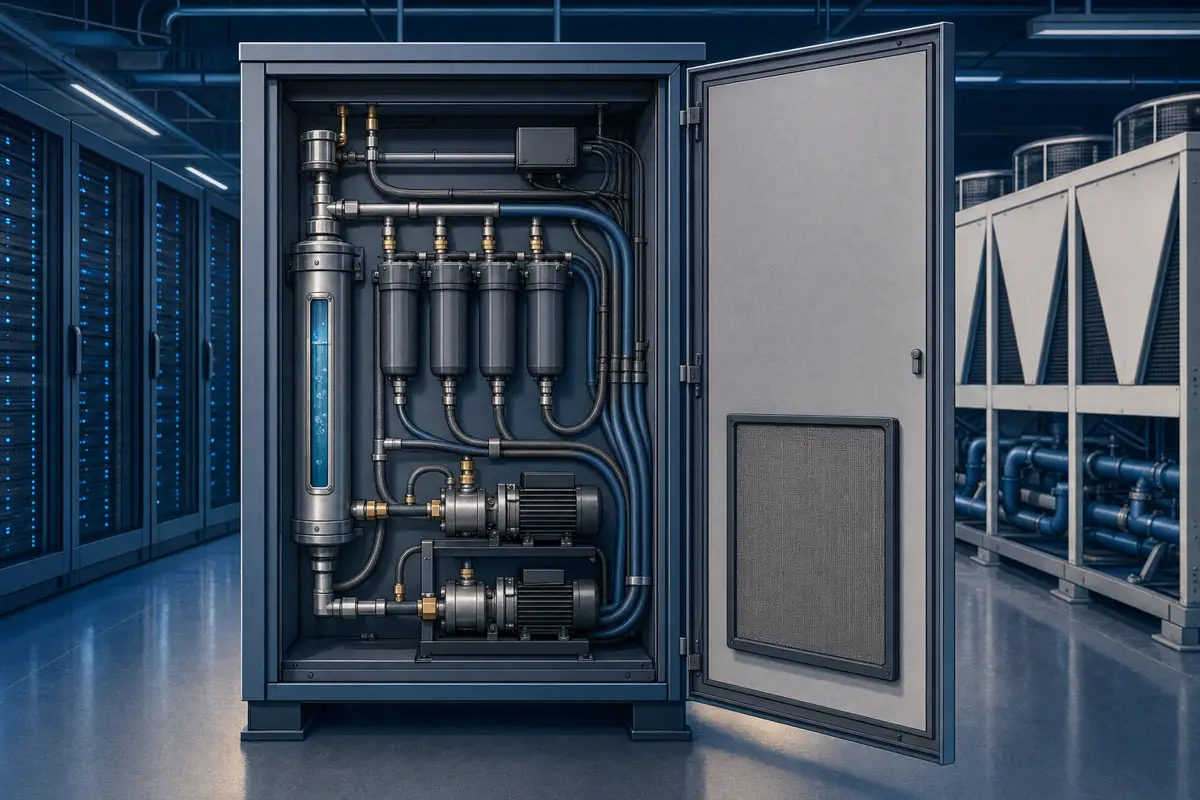
Vertiv's services cover flushing, filling, filtration and fluid chemistry for liquid cooling loops.AI-generated illustration
The services Vertiv lists are engineered flushing, precision filling, commissioning, filtration, fluid chemistry management, leak detection and monitoring through its Next Predict analytics platform. The release does not give prices, regions or availability dates.
"AI is changing liquid cooling from an equipment decision into a system-management imperative," said Ron Bednar, Vertiv's senior vice president of global and Americas services. The release carries no quotes from Dow or Solenis.
The National Laboratory of the Rockies modeled cold stored in deep underground formations, charged by dry coolers in cooler months, at data center sites in Virginia and Arizona.